Letter from Shunichi Watabe to Kyoichiro Kaga
The Final CurtainThe Letter from Shunichi Watabe to Kyoichiro Kaga is a five-page photocopy that reaches Kaga after his mother’s death, carrying the account of Yuriko Tajima’s inner life that he had long wanted to understand. Written by the man who loved Yuriko in Sendai and relayed through Hiromi Asai and Shuhei Matsumiya, it converts a chain of absences into a record: of Yuriko’s depression, her fear for her son, and the happiness she found in learning what kind of man he had become.
Form and Delivery
The letter arrives not directly from Watabe but through several hands. Matsumiya places a white envelope on the table with Tokiko Kanamori, explaining that it contains a photocopy of the original and that the suspect, Hiromi Kadokura, whose real name is Hiromi Asai, had possessed it. He asks Kanamori to pass it to Kaga, because Yuriko’s father had been keen for Kaga to see it. The envelope’s route makes the document a delayed handover rather than a private exchange between writer and recipient: Watabe cannot meet Kaga face-to-face, and Hiromi’s own accompanying note says that her father’s last message made clear he wanted the letter delivered.
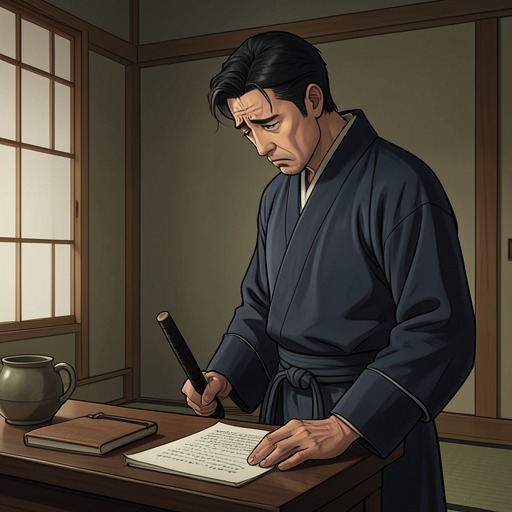
After Matsumiya leaves, Kanamori opens the envelope and finds five photocopied sheets. The first is Hiromi’s apology to Kaga for the trouble she and her colleagues have caused, and her explanation that she is forwarding her father’s letter because she believes his words will matter to him. The next page bears Watabe’s dense, forcefully written message, addressed to Kaga. Its physical intensity contrasts with the hesitant, mediated means by which it travels: a handwritten account reproduced on paper, entrusted to others because its author says he is nearing the end of his life and cannot communicate in the ordinary way.
Watabe’s Account of Yuriko
Watabe identifies himself as the man who had a long-term relationship with Yuriko in Sendai and as the person who gave Yasuyo Miyamoto Kaga’s contact details. He explains that he is writing to describe Yuriko’s emotional state after she left Kaga and his father. Yuriko did not speak of her family during the first year of their relationship; then, suddenly, she told him the story. In her own understanding, she had been a burden to her husband from the beginning of their marriage. Her conflict with her in-laws had forced him to break with his family, and she carried guilt that, despite demanding more time to care for her sick mother, she had still lost her mother relatively soon.
Watabe presents these accumulated burdens as the context for Yuriko’s collapse in self-worth. Convinced she was useful to no one, she doubted whether she could raise a child and, in Watabe’s assessment, likely had clinical depression at a time when people around her did not recognize depression as an illness. Instead, she persuaded herself that she was a failure. For years she endured that state, eventually developing an unhealthy fixation on suicide. Watabe says the sight of her sleeping son was what could pull her back: she worried who would care for him if she were gone. The letter gives Kaga a painful explanation for his mother’s departure without reducing her to that choice; it shows the prolonged distress and maternal concern that existed behind it.
The Magazine and the Son She Watched from Afar
The letter’s central recollection turns on a kendo magazine. After Yuriko had spoken about Kaga, Watabe went to a neighbor and learned that her son had moved out and was living elsewhere. The neighbor also told him that Kaga had recently won a kendo competition. Watabe went to a bookstore, found a magazine with Kaga in it, and brought the article back to Sendai to show Yuriko. Her breath caught as she stared at the photographs; her eyes filled with tears. She said she was happy, and Watabe understood that she was proud to see the fine young man her son had become—and pleased, too, that he had joined the police.
What relieved Yuriko most was evidence that her departure had not poisoned the bond between father and son. She had feared that Kaga blamed his father for driving her away and hated him. In her reasoning, Kaga’s choice to enter the same profession as his father showed that this fear had not come true. She said that this was a load off her chest, and Watabe remembers her smiling with a radiance he had never seen before. Her joy is qualified by renunciation: although the magazine gave her pleasure, she refused to keep it, believing that she had abandoned her duties as a mother and therefore had no right to hold on to it. She thought that keeping the pictures might hold Kaga back, when she wanted him to go from strength to strength. Watabe reads this refusal not as lack of attachment but as love expressed through self-denial and hope for her only son.
A Final Message, and Its Limits
Watabe closes by saying that he believes Yuriko made the best of the life she had been dealt. When work took him away from Sendai and he saw her for the last time, he asked if she wanted anything. She answered that she was happy as she was and needed nothing, smiling as she said it. He believes she was telling the truth, but also admits uncertainty: perhaps this is what he wants to believe. That qualification matters to the letter’s character. Watabe offers Kaga a witness’s intimate memories, not an omniscient account of Yuriko’s feelings, and he marks the boundary between what he saw and what he can only infer.
The letter is also Watabe’s attempt to forestall regret. He says he has spent his life trying not to be noticed or interfere in other people’s lives, but, with his own life approaching its end, he has begun to question whether silence is fair to the woman who meant more to him than anyone else and to her son. He apologizes for writing so late and doubts the information will have practical use, yet insists on giving Kaga some understanding of Yuriko’s state of mind. Signed by Shunichi Watabe, the document cannot restore the years in which mother and son were separated or replace a face-to-face conversation. It does, however, deliver what Kaga has sought: a credible, tender account of the mother whose feelings remained beyond his reach, and a final testimony that her love persisted in the very act of letting him go.